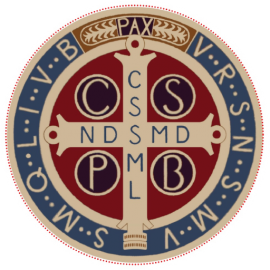
Saint Benedict of Nursia was a sixth-century Italian monk and abbot whose Rule helped shape Western monastic life. His life began in Italy around the year 480 and led him from the schools of Rome to a cave at Subiaco, then into the demanding work of guiding a community. The Rule he left behind still shapes monastic life and offers wisdom to people whose daily responsibilities lie far beyond a monastery.
Most of what we know about his life comes from Pope Saint Gregory the Great, who wrote about him several decades after his death. Gregory gathered accounts from Benedict’s disciples and told them as a life of holiness, filled with miracles and echoes of Scripture. His purpose was to show God at work in a human life. Reading him with that purpose in mind helps us appreciate these beloved stories without expecting the detail or chronology of a modern biography.
Saint Benedict at a glance
- Born: around 480 in Nursia, now Norcia, Italy.
- Died: traditionally around 547 at Monte Cassino.
- Known for: the Rule of Saint Benedict and his influence on Christian monastic life.
- Patron of Europe: proclaimed by Pope Saint Paul VI in 1964.
Leaving Rome
Benedict was born in Nursia, now called Norcia, in central Italy. His family sent him to Rome for an education. Gregory tells us that the conduct of other students troubled him, and he feared being drawn into the same way of living. He left his studies to seek a life devoted to God.
He first stayed at a village traditionally identified as Affile. There Gregory places the story of a broken sieve, borrowed by the woman who had cared for Benedict since childhood. Seeing her distress, Benedict prayed, and the sieve was restored. The attention that followed did not keep him there. He withdrew to the hills near Subiaco.
The cave at Subiaco
A monk named Romanus helped Benedict begin his solitary life, giving him a monastic habit and bringing food. Gregory describes Romanus lowering bread on a rope to the cave where Benedict lived for three years. Even this period of solitude depended on another person’s kindness.
In time, people began seeking Benedict out. A nearby community asked him to become its abbot. He accepted reluctantly, warning that their ways of life were very different. The arrangement ended badly. In Gregory’s account, monks who resented his discipline tried to poison his wine. When Benedict made the sign of the cross over the cup, it shattered. He left them and returned to Subiaco.
Others were willing to learn from him. Gregory describes twelve small monasteries gathered around Benedict’s guidance, with an appointed superior for each. The hermit had become a teacher responsible for the spiritual growth of others.
Monte Cassino and the Rule
Benedict eventually moved south to Monte Cassino, where the foundation of his monastery is traditionally dated to 529. This became the home most closely associated with his later life and his Rule.
He drew on a monastic tradition already centuries old. His contribution was a practical guide for a community seeking God under an abbot. The Rule makes room for the daily work of keeping a household, caring for the sick, and welcoming guests. Prayer and sacred reading give the day its direction. The details matter because the people who share this life must learn to love one another through them.
Benedict expects much of his monks, but he also knows their limitations. The abbot must listen to the community, including its youngest members. He must adapt his guidance to different needs and take care that correction does not crush the person being corrected. The sick are to receive particular care. Guests are to be welcomed as Christ.
In the Prologue, Benedict describes the monastery as “a school of the Lord’s service.” That school asks for a lifetime of learning. Near the Rule’s end, he urges the brothers to bear one another’s weaknesses patiently and to seek one another’s good. His hope is expressed in a simple prayer. “May he lead us all together to eternal life.”
Saint Scholastica
One of Gregory’s most tender stories concerns Benedict’s sister, Saint Scholastica, who had also dedicated her life to God. They met once a year near his monastery to pray and speak about spiritual things.
At their last meeting, Scholastica asked her brother to stay through the night so they could continue their conversation. Benedict refused because he would not remain outside the monastery overnight. She bowed her head and prayed. Gregory tells us that a sudden storm made it impossible for him to leave.
Brother and sister spent the night together in holy conversation. Gregory sees her answered prayer as the strength of love. Three days later, he tells us, Benedict saw her soul rising to heaven in the form of a dove. He had her buried in the tomb prepared for himself.
A life that continues to teach
Benedict died at Monte Cassino, traditionally around 547. Gregory describes his final moments in the oratory. After receiving Holy Communion, he stood in prayer with his brothers supporting his weakened body. The man who had once sought God alone in a cave ended his life held by his community.
The Benedictine family grew over the centuries as monasteries adopted his Rule. Today, monks and nuns continue to live it in community, while oblates and other lay readers draw on its wisdom within their own vocations. Pope Saint Paul VI proclaimed Benedict patron of Europe in 1964.
For those meeting him for the first time, his Rule is a good place to begin. Read a little, take time with it, and notice how often its teaching returns to the people closest at hand. Benedict’s enduring concern is how a life given to God can become a life of patient, faithful love.
Questions about Saint Benedict
When is Saint Benedict’s feast day?
The Church celebrates Saint Benedict on July 11. Benedictine communities also commemorate his passing on March 21. The two dates reflect different celebrations of the same saint.
Can I follow Benedict’s wisdom without becoming a monk or nun?
Yes. Many laypeople read his Rule for guidance in prayer and daily life. Benedictine oblates make a particular commitment to this way of life in association with a monastery. You can begin simply with a short daily reading from the Rule.
Read further
- Read our edition of the Rule of Saint Benedict
- Follow the daily reading from the Rule
- Explore Saint Gregory’s account of Benedict’s life
This biography draws on Saint Gregory the Great’s Dialogues, Book II, the Benedictine Confederation’s historical introduction, and Pope Benedict XVI’s audience on Saint Benedict. Dates are approximate or traditional where indicated. Feast-day information follows Vatican News and the Benedictine Confederation. Rule quotations are from The Rule of Saint Benedict, edited by Brian Junyor (2026), CC BY 4.0.