
Benedictine saints · February 10
Who she was
Saint Scholastica was the sister of Saint Benedict. She gave her life to God from childhood. Her feast is February 10.
We know her chiefly through two short chapters by Saint Gregory the Great. In the first, she asks her brother for one more night of conversation. In the second, he sees her soul rise to heaven. Gregory remembers a woman whose love gave her the courage to ask for what even Benedict could not give her.
What we know
Gregory wrote about Scholastica in Book II of his Dialogues, his account of Benedict’s life. He tells us that she visited her brother once a year and that they met on the monastery’s grounds, just outside the gate. He gives us almost nothing about her life apart from that visit and what followed it.
Later tradition calls Scholastica Benedict’s twin and places her community near Monte Cassino. Gregory does not say they were twins or tell us where she lived. The only words of hers we have are the ones he gives her in this story.
The last meeting
Saint Gregory the Great, Dialogues, Book II, chapter 33. A fresh English rendering from the Latin, beginning with Scholastica’s annual visit.
Scholastica, the sister of Benedict, had been consecrated to almighty God from her earliest childhood. It was her custom to visit him once each year, and the man of God would come down to meet her at a house belonging to the monastery, not far beyond its gate.
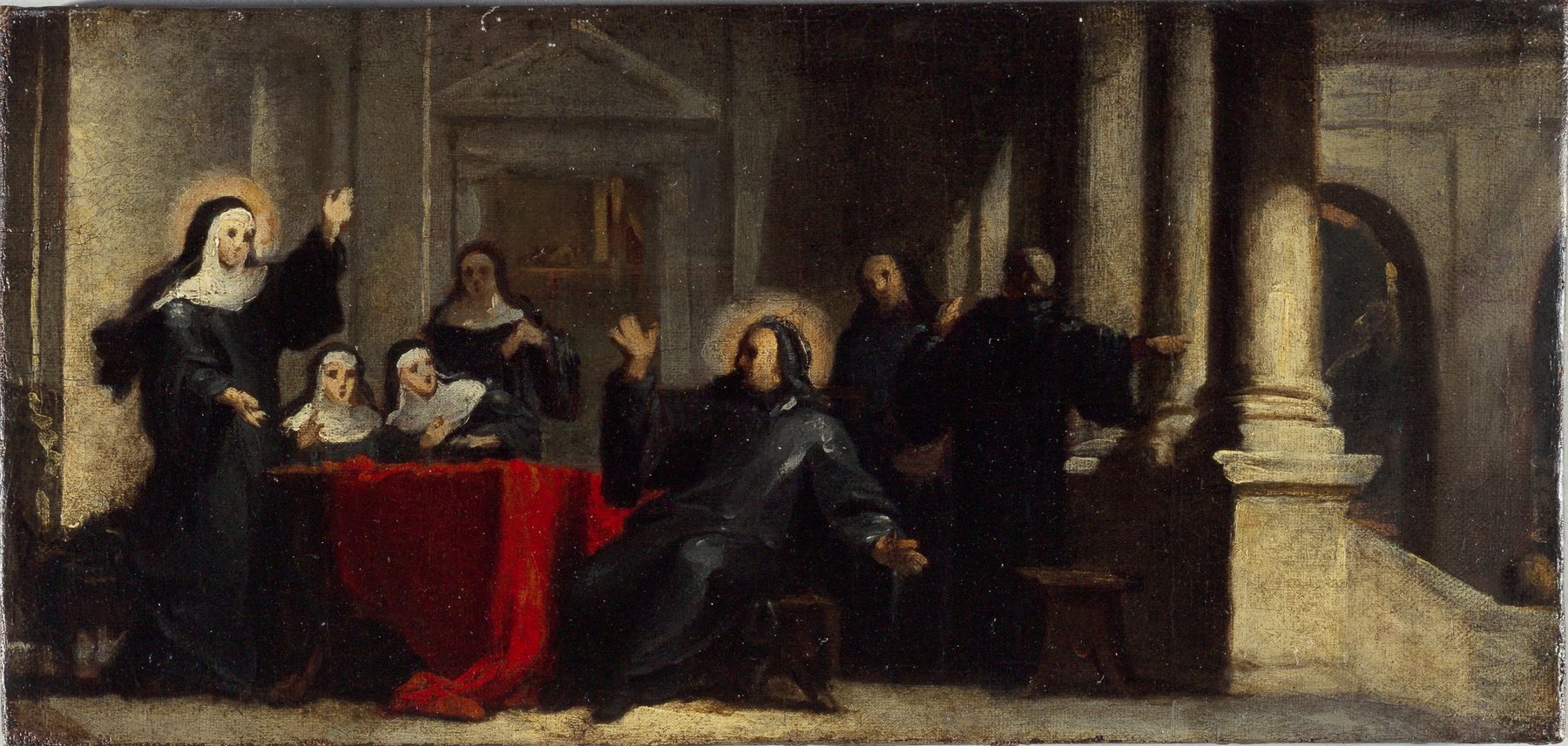
On one such day she came as she always did, and her venerable brother went down to her with some of his disciples. They passed the whole day in the praise of God and in holy conversation, and as the darkness of night settled around them, they shared a meal together. They were still seated at the table, and the hour had grown late as they spoke of sacred things, when the holy woman turned to her brother and pleaded with him. “I beg you, do not leave me tonight. Stay, so that we may speak until morning of the joys of the heavenly life.”
“What are you saying, sister?” he answered. “I cannot possibly spend the night outside my cell.”
The sky that evening was so serene that not a single cloud could be seen. But when the holy woman heard her brother’s refusal, she laid her hands upon the table with her fingers interlaced and rested her head on her hands to pray to almighty God. And as she raised her head from the table, there burst forth such lightning and thunder, and such a flood of rain, that neither the venerable Benedict nor the brothers who were with him could set foot beyond the threshold.
For as she bowed her head into her hands, she had poured out a river of tears upon the table, and by those tears she drew rain from a cloudless sky. Nor did the storm come a little after her prayer. So perfectly did the prayer and the downpour meet that she lifted her head to the sound of thunder, and the raising of her head and the falling of the rain were one and the same moment.
Then the man of God, seeing that he could not return to the monastery through the lightning and thunder and the great flood of rain, grew sorrowful and began to complain. “May almighty God forgive you, sister,” he said. “What have you done?”
“I asked you,” she answered, “and you would not listen to me. So I asked my Lord, and he listened to me. Go now, if you can. Leave me here and return to your monastery.”
But he could not so much as step out from under the roof. He who would not stay of his own will now remained against it. And so they kept vigil through the whole night, each feeding the other’s soul with holy conversation about the spiritual life.
The dove
Saint Gregory the Great, Dialogues, Book II, chapter 34. A fresh English rendering from the Latin.
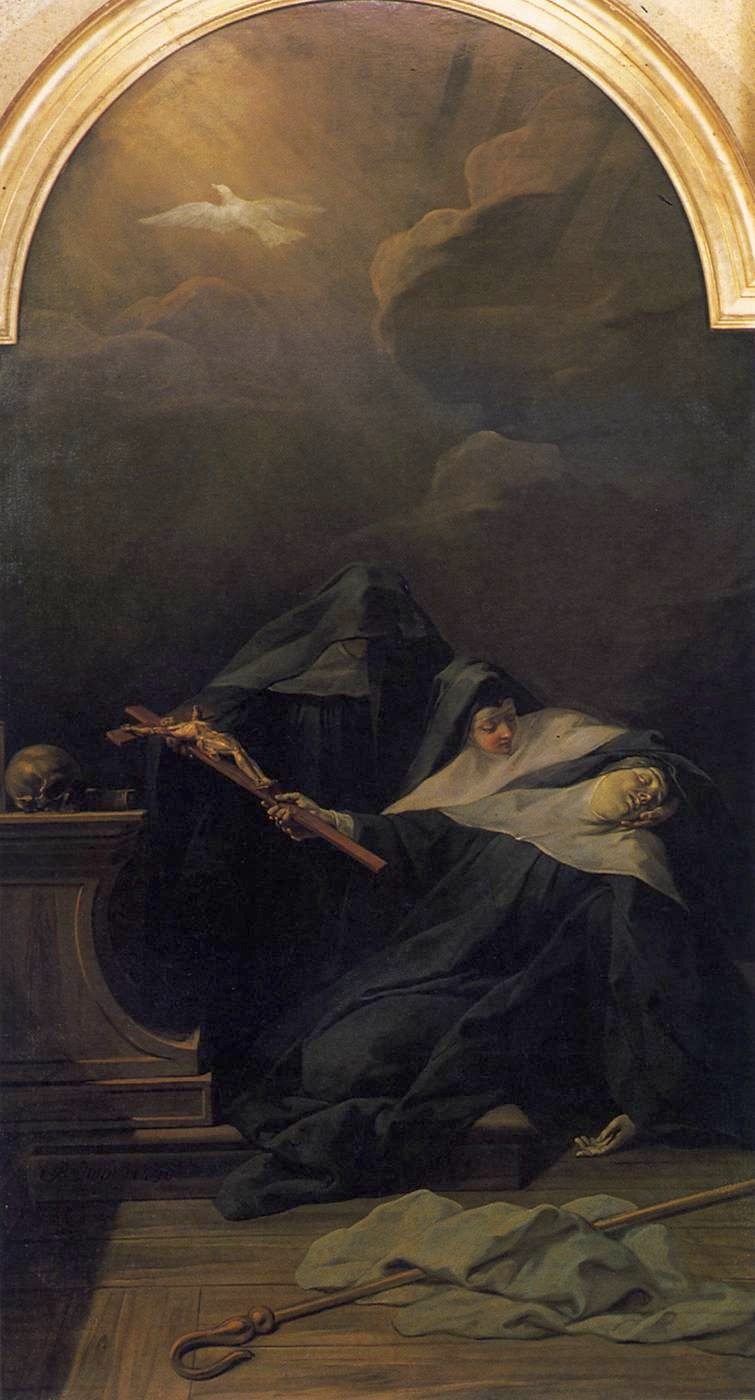
The next day the venerable woman returned to her own cell, and the man of God went back to his monastery. Three days later, as he stood in his cell, he lifted his eyes to the sky and beheld the soul of his sister, newly gone from her body, rising in the form of a dove into the hidden courts of heaven.
Rejoicing in the greatness of her glory, he gave thanks to almighty God in hymns and songs of praise, and announced her passing to his brothers. He sent them at once to bring her body to the monastery and lay it in the tomb he had prepared for himself.
So it was that those whose minds had always been one in God were not parted even in the grave.

She loved more
This is a strange story to keep in a tradition built on a Rule. Benedict has good reason to return to his monastery. Gregory takes that obligation seriously enough to let us feel what it costs Benedict to stay. Yet the person who sees most clearly what this particular night asks of them is his sister.
Scholastica doesn’t argue her case. She takes it to God. In the Prologue to the Rule, Benedict says that as we go on in faith, our hearts open wide and we run the way of God’s commands with the sweetness of love. On that last night, his sister gave him a chance to live something he had put into words.
There is something else here too. A brother and sister who had both given everything to God still made time to see each other. By morning, they had been given something neither would have again in this life: another night at the same table.
Feast day and patronage
The Church remembers Saint Scholastica on February 10. Benedictine nuns and sisters honor her as a patron, and she is traditionally invoked against storms. Monte Cassino honors her tomb beside her brother. The Diocese of Le Mans also records a long tradition of venerating relics attributed to her.
A prayer to Saint Scholastica
Saint Scholastica, you asked and God listened, because you loved much.
Teach me to pray with that same trust.
When my plans and rules get in the way, remind me that love comes first.
Pray for all who seek God together, for brothers and sisters, friends and families, and bring us at last to the joys of heaven you longed to talk about that night.
Amen.
Continue reading
Sources
- Gregory the Great, Dialogues II.33–34. Latin text, Sources Chrétiennes 260, pp. 230–245; compared chapter 33 with the Patrologia Latina text. Gregory invokes 1 John 4:8, 16 in chapter 33.
- The Rule of Saint Benedict, Prologue §49, paraphrased.
- Vatican News, Saint Scholastica; Diocese of Le Mans, Église Saint-Benoît.
Gregory’s comment
From the close of chapter 33.
Benedict had wished, Gregory tells Peter, that the clear sky he found on coming down would remain. But against his wish he met a miracle, worked by the power of almighty God from the heart of a woman. Small wonder that she, who had long desired to see her brother, could in that hour do more than he. For as Saint John says, God is love, and by a most just judgment she could do more, because she loved more.
“I confess,” Peter replies, “that what you say pleases me greatly.”