The Order of
Saint Benedict
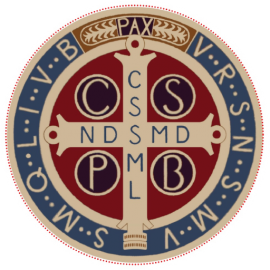
The Order of Saint Benedict grew from a Rule written for the life of a monastery into a tradition that has helped shape the Church and the world for fifteen centuries. Its history includes prayer and scholarship, missionary work and hospitality, periods of great influence, and repeated efforts at renewal. The initials O.S.B., from Ordo Sancti Benedicti, identify a belonging expressed through particular communities, each with its own history.
That local character is important. Benedict did not establish a centralized international order in its modern form. The institutions that connect Benedictine monasteries today developed gradually, in response to the needs of communities living the same Rule in different places and circumstances.
From Benedict to Gregory and the spread of the Rule
Benedict’s later influence would have been difficult to imagine from the troubled history of his first foundations. Monte Cassino was attacked by Lombards in the late sixth century, commonly dated around 580, and the monks withdrew to Rome. The monastery remained abandoned until its restoration under Petronax in the early eighth century. The Montecassino manuscript research partnership records this first destruction and return. The survival of the Rule mattered all the more when the community’s buildings could not survive.
Benedict had not sought the fame that later gathered around his name. In Gregory’s telling, he withdraws when his first miracle attracts attention. It is tempting to imagine that obscurity would have suited him. What we can say with greater confidence is that his memory reached a far wider audience through a pope writing several decades after his death.
Saint Gregory the Great, pope from 590 to 604, had himself been a monk. Before entering monastic life, he had served in Roman civil administration, and as pope he faced famine, disease, political disorder, and the threat of the Lombards. His experience joined contemplation with the urgent practical needs of the Church. Pope Benedict XVI’s introduction to Gregory places his monastic background within that larger life of service.
Gregory devoted Book II of his Dialogues, written in the 590s, to Benedict. Drawing on accounts from four disciples, he presented a man whose holiness showed God at work amid the troubles of the age. Without this work, we would know far less about Benedict’s life. Gregory also praised the Rule, helping to bring its author and teaching into the Church’s wider memory. Our complete text of Gregory’s account preserves that early witness.
Saint Scholastica belongs within this story from the beginning. Gregory describes Benedict’s sister as dedicated to God and tells of their meetings for prayer and spiritual conversation. Her place in Benedictine memory is rooted in that witness, especially the account in which her prayer allows their final conversation to continue through the night. Her place beside Benedict remains central to the tradition.
The Rule spread into Gaul and elsewhere, sometimes alongside other monastic rules. English monks helped carry its observance to continental Europe. The Carolingian reforms of 816–817 made it a common standard across the empire. Its influence grew through communities of both men and women, rather than through a single administrative organization established by Benedict himself.
Cluny and the work of reform
Success brought difficulties as well as opportunities. Wealth and the control exercised by local rulers could weaken a monastery’s freedom to live its vocation. Founded in 910 in Burgundy, in what is now eastern France, Cluny became a center of renewal that placed the liturgy at the heart of community life. William, Duke of Aquitaine, provided the foundation, and Berno became its first abbot. What began as one monastery developed into an extensive network whose influence reached across Europe.
Papal protection helped Cluny maintain independence from local interference. Its abbots were elected without control by civil authorities, and its relationship with Rome supported the spread of its reform. Other houses became connected to Cluny through different forms of dependence or association.
Cluniac influence extended beyond the cloister. Its communities sustained prayer for the living and the dead, welcomed the poor, cultivated sacred music, and contributed to movements for peace. Pope Benedict XVI explored these connections in his 2009 audience on the Cluniac reform. Cluny illustrates how a renewal of monastic observance could also affect the wider Church and society.
Monasteries in the medieval world
Between the rise of Cluny and the later formation of congregations lies a rich history of communities engaged with the world around them. Monasteries were places of worship, but also landholders, employers, schools, and centers of writing and exchange. Their relationships with patrons, rulers, neighboring towns, and other religious houses shaped their daily lives. A history concerned only with reforms and foundations would miss much of what made them important.
Learning grew from this common life. Anselm’s career carried him from the monastery and school of Bec in Normandy to the archbishopric of Canterbury. His teaching joined prayer with disciplined theological inquiry, while his public responsibilities drew him into conflicts over the Church’s freedom. Benedict XVI’s audience on Saint Anselm shows how study, spiritual leadership, and governance could belong to one monastic vocation.
Women’s communities were part of this intellectual and spiritual world. Saint Hildegard of Bingen’s writings, music, and correspondence reveal the range of a twelfth-century Benedictine abbess’s work. Bishops, abbots, and communities sought her counsel. Her example makes it impossible to tell the medieval Benedictine story as though its learning and influence belonged only to men. Benedict XVI explored this breadth in his teaching on Hildegard.
Montecassino’s own fortunes show how closely culture and power could be joined. After another destruction in 883, its community eventually returned. Under Abbot Desiderius in the eleventh century, the abbey became an important center of art and books. Desiderius later became Pope Victor III. The monastery then endured political conflict and the earthquake of 1349. Its history contains achievement, vulnerability, and rebuilding, not a simple passage from one golden age to another.
New movements also challenged established habits. The Cistercians sought a more austere observance of the Rule. Bernard of Clairvaux urged simplicity in food, clothing, and buildings, while becoming deeply involved in the affairs of the Church. His life and teaching belong to the wider Benedictine inheritance, although the Cistercians developed their own organization. The emergence of other orders did not bring Benedictine life to an end; it placed it within a more varied religious landscape.
For a fuller scholarly treatment of this long period, James G. Clark’s The Benedictines in the Middle Ages follows the Order through its observance, social relationships, culture, and later medieval history.
Congregations, upheaval, and renewal
Papal initiatives in 1215 and 1336 sought stronger organization among Benedictine houses. From the fifteenth century, congregations became increasingly important. The reform centered on Saint Justina in Padua, later known as the Cassinese Congregation, provided an influential model. Congregations offered a way for houses to sustain observance and support one another without making every monastery identical.
The following centuries brought both expansion and loss. Benedictine foundations in Brazil carried the tradition beyond Europe. In Europe itself, the Reformation, government suppression, revolution, and war closed many houses. Some communities disappeared; others survived elsewhere or were restored. Nineteenth-century foundations and revivals renewed monastic life under changed conditions. An old tradition could take root in a new house, and a restored monastery had to find its place in a different society. The Confederation’s historical overview traces these changes.
The Confederation and the Abbot Primate
In 1893, Pope Leo XIII established the Benedictine Confederation through the brief Summum semper. The congregations of monks are its ordinary members, and certain individual monasteries belong directly. The Confederation provides a common institution while preserving the distinct government of its constituent communities.
The Congress of Abbots elects the Abbot Primate, who heads the Confederation. This office does not replace the abbots of individual monasteries or the superiors of congregations. It gives the Order a shared center of service and representation. The Congress meets every four years, and the abbots president of the congregations meet in an annual synod.
The Abbot Primate resides at Sant’Anselmo in Rome, which also houses the Confederation’s curia, a pontifical athenaeum, and a college where monks live while studying, teaching, or working in Rome. The Confederation’s official account explains its membership and governance.
Benedictine nuns and sisters have their own communities, histories, and forms of government. Their place in the tradition is integral, rather than an extension of the men’s congregations. The communities associated with the Confederation are brought together through the Communio Internationalis Benedictinarum, the International Communion of Benedictine Women. This provides a bond among communities whose circumstances and observances differ.
The popes and Benedict’s continuing importance
Papal involvement has included protection, reform, and the creation of institutions, but it has also recognized the spiritual and cultural significance of Benedictine life. On 24 October 1964, Pope Saint Paul VI proclaimed Benedict patron of Europe in Pacis nuntius. The proclamation accompanied the dedication of the rebuilt church at Monte Cassino. It honored a tradition whose contribution joined faith, learning, and work, even amid Europe’s divisions and destruction.
Pope Benedict XVI returned to the saint’s teaching with particular care. In his audience of 9 April 2008, he presented prayer as the foundation of Benedict’s life without separating it from practical responsibility. Listening must become action. The abbot must be an educator who listens as well as teaches, and the monk’s search for God takes shape through humility, obedience, and service.
For Benedict XVI, the Rule’s enduring strength lay in its moderation, humanity, and discernment. His treatment helps explain why the Order’s history cannot be understood only through foundations, congregations, and buildings. Those institutions serve a way of life whose purpose must be renewed by each generation.
At Cassino in 2009, he again connected Benedictine spirituality with prayer, work, and culture, emphasizing the monks’ love of Scripture and lectio divina. His homily on that visit offers a useful companion to the earlier audience.
Pope Leo XIV’s visits in July 2026 brought this relationship into the present. On 20 July he visited Montecassino, prayed at Saint Benedict’s tomb for peace, and shared lunch with the monks. Two days later he visited the monasteries of Saint Benedict and Saint Scholastica at Subiaco in Italy. These were visits to living communities as well as places associated with Benedict’s beginnings. Vatican News reported the visits to Montecassino and Subiaco.
Addressing the International Communion of Benedictine Women at the Vatican on 12 September 2026, Leo recalled those pilgrimages and recognized the communities’ prayer, spiritual guidance, and theological reflection. His address connects the ancient monastic places with the worldwide Benedictine life of today.
The monastery at the center
Through these changes, the monastery has remained the center and heartbeat of Benedictine life. The Rule gives the community a daily rhythm of liturgical prayer, sacred reading, and work. It also attends to meals, clothing, sleep, illness, guests, and the care of tools. Such practical details show how thoroughly the spiritual life belongs to the common life. A monastery must learn to pray together and to care for the people and things entrusted to it.
Monastic profession commits a person to stability, obedience, and a monastic way of life. Stability gives particular weight to belonging to a community. The abbot’s responsibility is both spiritual and practical. He must guide the household, seek counsel, and take account of different needs. The Rule places demands on the superior as well as on those who obey him.
This is the foundation beneath the Order’s varied works. Education, scholarship, hospitality, farming, and crafts take their place within a life directed toward God. Some monks are ordained priests, while others live their vocation without ordination. The Rule itself remains the clearest introduction to the pattern they share.
This life also reaches beyond the cloister. Oblates do not simply adopt a set of practices in isolation; their association with a particular monastery joins their daily prayer and work to a community living the Rule.
Oblates and life beyond the monastery
The word oblate comes from offering. In the early monastic tradition it could describe children offered by their families for life and education in a monastery, a practice addressed in chapter 59 of the Rule. Over time, adults also formed relationships with monasteries while remaining in their own homes and occupations. These different historical forms should not be treated as identical to modern oblation. The Benedictine introduction to oblates traces that development.
Saint Frances of Rome gives this history a human face. On 15 August 1425, she and nine companions made their oblation, joining prayer to care for people in poverty. These women initially lived in their own homes under the spiritual direction of the Olivetan Benedictines; some later formed a community. Their story is an important chapter in oblate history, though their later communal life should not be confused with every form of oblation today. The Vatican’s anniversary message recalls their offering, while Saint John’s Abbey’s history explains its development.
The seventeenth-century scholar Elena Lucrezia Cornaro Piscopia offers a different example. Awarded a philosophy doctorate at Padua in 1678, she was also a Benedictine oblate. Her intellectual work belonged to a life of religious observance and service to the poor. The University of Padua records her choice of oblation, while Vassar College’s account recalls both her learning and her charitable life.
Today, oblates associate themselves with a particular community and seek to live the spirit of the Rule within their own vocation. They do not become monks or nuns by making oblation. Their connection places prayer, work, and service in relationship with a monastery’s life.
Dorothy Day offers a notable example. The co-founder of the Catholic Worker movement became an oblate of Saint Procopius Abbey in Illinois in 1955. Her attachment to Benedictine spirituality accompanied a life spent among the poor and in the work of hospitality and social witness. Portsmouth Abbey’s account explores that relationship. Her story shows how association with a monastery could nourish a demanding vocation lived far from the cloister.
A later example is the writer Kathleen Norris, an oblate of Assumption Abbey in Richardton, North Dakota. Her The Cloister Walk (1996) introduced many readers to Benedictine prayer and daily life. The Order’s resource page records her monastic association, and Saint John’s Abbey notes the book’s contribution to wider interest in Benedictine spirituality. Alongside Frances’s charitable work and Day’s hospitality, Norris’s writing shows another way this connection can bear fruit beyond the monastery.
Looking toward the Benedictine Jubilee
The Benedictine Jubilee of 2029 will commemorate the 1,500th anniversary of Montecassino’s foundation in 529. Organized by the Benedictine Confederation, it invites communities to give thanks for their inheritance and consider how monasteries can continue to be places of hope.
The preparation follows a four-year journey. It begins with Awaken in Norcia in 2026, continues with Listen in Rome in 2027 and Grow in Subiaco in 2028, and reaches Flourish at Montecassino in 2029. The sequence returns to the places that shaped Benedictine life while asking what that life can offer the present.
The official Jubilee website brings together monastery stories, pilgrimage information, and opportunities to participate. Its Journey to Jubilee explains the preparation, and pilgrimage plans include visiting monasteries with a Pilgrim Passport. As arrangements develop, the site is the best place to find current details.
After fifteen centuries of growth, disruption, and renewal, the Jubilee offers more than an anniversary to observe. It is an invitation to consider how the Rule continues to take flesh in communities, and how the search for God can make those communities places of welcome and hope.